New Year, New You: Choosing Mental Health First

The start of a new year often brings reflection — quiet moments when people think about what’s working, what isn’t, and what they want for the months ahead. Many military veterans, though, share that given their training, asking for help can feel uncomfortable.
From day one, service members train to put the mission first, suppressing discomfort and personal challenges for the greater good. That mindset can be lifesaving while in uniform, but over time, ignoring or pushing things aside can take a toll on one's physical, emotional, and mental health.
Learning to put yourself first is a difficult lesson. Just ask warriors Angie Peacock and Chris Kellum. When they chose to prioritize their own well-being, with support from Wounded Warrior Project® (WWP), they found greater balance, clarity, and a better quality of life.
From Survival to Self-Care

Angie Peacock joined the Army to serve a mission bigger than herself. However, after her medical retirement in 2006, she found herself in a state of uncertainty. Feeling invisible, Angie wondered if she even had a future.
“I had been in the Army for six years and nine months at that time, so that was my identity,” Angie recalls. “I remember lying on the couch… thinking, ‘What am I supposed to do now?’”
As she tried adjusting to civilian life, pain from service-related injuries, post-traumatic stress disorder (PTSD), anxiety, and depression took over. At one point, Angie was taking 18 different medications just to get through the day.
“I had pushed everything down and just became a patient. That was my role. Any hope or sense of self disappeared.”
Finally, after more than a decade, Angie decided she’d had enough. When she connected with WWP™, she found a supportive community of fellow veterans and mental health resources that helped her begin healing. She credits WWP’s outdoor adventure-based mental health program, Project Odyssey, as a turning point in reframing her outlook on life.
“Project Odyssey is like a pause button. You get a chance to pause, to reflect, and look at your life. You get exposed to new ideas that can help you mentally, physically, and emotionally. And you see that you are part of a community, and you realize, ‘Wow, I'm not as alone as I feel out here,’” Angie explains.
Soon, with that support, Angie began rebuilding herself. She embraced alternative therapies like yoga, meditation, and acupuncture. She pursued a degree in social work. And she came up with the makings of a plan to put herself first.
“I had not been living for 15 years. It was time to live and learn who I was again,” she says.
When the Body and Mind Say Enough

In 2019, as a newly graduated social worker and professional coach, Angie hit the road, traveling cross-country in her RV, all while supporting clients virtually.
Life on the road was unpredictable at times. So, too, was building her business. Eventually, Angie realized that her body was sending signals, and she needed to listen.
“When I’m not sleeping well, or I’m getting short with clients, when I need more coffee just to function, that’s my body talking to me,” Angie says. “I had to take action to help myself feel better.”
Angie deliberately reduced her work schedule, and she sets firm boundaries when it comes to rest and relaxation. More importantly, Angie adds, “I’m building a life I don’t need to recover from.”
Learn More about Veteran Mental Health and Wellness Support
Finding Support to Let Go

For Chris Kellum, structure and movement were grounding. The gym was a place for him to work through stress and emotions. Later, it became a way to prepare for his future.
“The gym was my safe place. If I felt antsy or irritable, I could go, and I’d feel better after a workout,” Chris says.
When he decided to join the military, his workouts didn’t cease. Rather, they increased. As a member of the Florida Army National Guard, Chris spent years conditioning his body. His long-term goal was to become a military pilot, so he wanted to be in the best shape possible.
In 2019, an unexpected health diagnosis, combined with policy changes during the COVID-19 pandemic, threatened his dream. Chris fought for an exception. Despite numerous physicals, medical tests, and evaluations, there was no clear-cut path for him to become a pilot.
The uncertainty about his future pushed Chris into a deep depression. He stopped working out, gained weight, pulled away from loved ones, and felt himself losing purpose. “I wasn’t showing up for anybody,” he admits. “I wasn’t there for myself, for my family, or for the person I loved.”
His mental health took a further dive after he was medically retired. “Part of me died, realizing I wasn’t going to wear the uniform anymore.”
At first, Chris resisted therapy, but eventually he agreed after encouragement from his girlfriend, who assured him of her support, no matter what the future held. That decision became a turning point.
“There is a negative stigma around going to therapy and being seen as weak,” Chris says. “But when I finally took that first step … therapy helped me evolve my mindset. I realized that what you value is more important than any end goal.”
Finding a Community and Moving Toward Healing
Through WWP, Chris found the support that helped him get back on his feet.
His passion for sports led him to connect with WWP’s Physical Health and Wellness team, which in turn led him to rediscover movement as a mental health tool.
“It gives me clarity and control when everything else feels uncertain,” says Chris, who has now taken up triathlons. “The long sessions of swimming, biking, and running became a form of meditation and therapy for me.”
Additionally, Chris found camaraderie again – something he’d been missing since his retirement. “When you leave, you lose structure, community, and purpose all at once,” he says. “If you don’t intentionally rebuild that support system, it’s easy to feel lost.”
Learn How You Can Gain Confidence and Improve Your Physical Health
Choosing the Time for Growth
“In the military, we’re taught to put other people’s needs first,” Angie says. “But you’ve got to say yes to yourself now. And it feels weird at first, but that’s normal.”
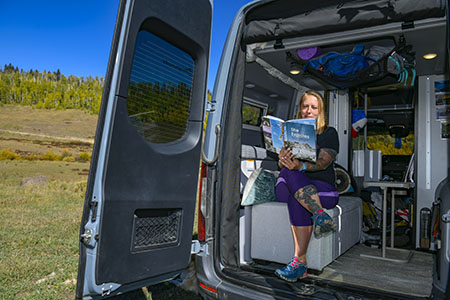
Angie often talks with her clients about when the right time is to make a change. “There’s this misconception that you have to wait until you feel better to take action. It’s actually the opposite. You should take action to help yourself feel better,” Angie says.
She encourages veterans to use the New Year as a time to reflect.
“Stop and look at your life holistically — your sleep, your relationships, your movement, your spiritual health. You will start to see where things are out of balance. Ask yourself what doesn’t feel good anymore. That’s usually where the work begins.”
For Chris, the time is whenever you make the decision to grow. “It starts with wanting to be better, being open to help, and being willing to grow,” he says.
Mental Growth Doesn’t Happen Overnight
Both Angie and Chris emphasize that prioritizing mental health takes small, intentional steps. Growth takes time and constant reinforcement.

“Confidence builds when you prove to yourself that you can do hard things — especially when you don’t feel motivated,” Angie explains, adding that progress may mean skipping dessert or walking a few blocks further than the day before. “It could also mean saying no to something.”
Positive self-praise also helps. “You might have to do it on purpose, though,” Angie says. “Like on day one, you say, ‘I am really proud of you. You walked last night when you didn't feel like it. Let's see what we can do tomorrow.’”
Chris also recommends bringing others along on your journey. “Be open-minded to listen to others, to get advice, and to take criticism. It will help you evolve your mindset.”
Although letting go of flight school was painful, Chris’s willingness to share and seek guidance led him to a new mission. “I found a new why,” says Chris, who today works as a personal fitness coach and app designer.
He recently launched an online platform offering customized training plans to help service members prepare for military fitness tests. “Just because I don’t fit into the military anymore doesn’t mean I still can’t have an impact.”
Finding Support on Your Journey
Prioritizing mental health can feel hard. However, putting yourself first and creating a balanced, meaningful life is possible. “Getting your health back can be scary. Wounded Warrior Project is there to help you on your journey,” says Angie.
Although every warrior's journey is unique, including how or why they first connect with WWP, support is always available. Veterans like Angie and Chris remind us that taking the first step to prioritize your mental health can open the door to a renewed you.
Discover Opportunities to Connect with WWP.
Contact: Cynthia Weiss – Public Relations, cweiss@woundedwarriorproject.org, 904.738.2589
About Wounded Warrior Project
Wounded Warrior Project is our nation’s leading veteran services organization, focused on the total well-being of post-9/11 wounded, ill, or injured veterans. Our programs, advocacy, and awareness efforts help warriors thrive, provide essential lifelines to families and caregivers, and prevent veteran suicides. Learn more about Wounded Warrior Project.

Veterans and service members often carry experiences from service that stay tucked away for years – not because they don’t matter, but because talking about them can feel exhausting. Over...

For many veterans, life after military service can look very different from what they expected. This is particularly true for men and women who have experienced trauma, including post-traumatic...

As the calendar flips to January, many people, including veterans and military families, reflect on the past year and identify opportunities for change in the coming year. Research shows that...