How Writing Helps Warriors Heal

Veterans and service members often carry experiences from service that stay tucked away for years – not because they don’t matter, but because talking about them can feel exhausting. Over time, these unspoken memories can begin to feel heavy and take a toll on sleep, stress, and everyday life.
Healing takes time. Wounded Warrior Project® (WWP) recognizes this and encourages small, steady habits that build mental resilience. One of the simplest, yet most powerful tools warriors can use is writing.
The practice of writing or journaling as a mental well-being tool can take many forms: hastily written sentences scribbled in a notebook, a list of thoughts, or a single line in the Notes app on your phone.
“Whatever you call it, and however you do it, the idea is to give thoughts somewhere to land instead of just swirling around in our brain,” says Margie Ensell, a WWP Talk team specialist, who helps participants find practical ways to cope with stress, process emotions, and establish routines that support their goals.
The Benefits of Journaling
When people hear the word “journaling,” they are often quick to say it's not for them. But Margie explains that journaling offers several benefits:
- It helps you feel less overwhelmed.
- It slows racing thoughts.
- It allows you to track patterns, progress, and accomplishments.
- It provides a safe space for you to work through your feelings.
Another benefit of journaling, Margie says, is that there is no right way to do it. "Some people write by hand. Some type on their phone. Other people use voice notes or record a daily video. The format is not important. The goal is expression, not perfection."

Finding Clarity and Identity
For Army veteran Angela Miller, writing began long before she ever wore a military uniform. Growing up with six siblings and very little privacy, she learned early how to keep her thoughts guarded.
“When I was growing up, we called it keeping a diary,” Angela says.
“I had a bad anger problem. I used to punch holes in the walls. One day, I just started writing. It became my release.”
As she wrote, clarity followed. “I realized what I thought I was angry at wasn’t really what I was upset about.”
The older she got, the less she put pen to paper. Then her Army unit deployed to Iraq, and Angela found that journaling once again helped her find her footing.
Angela left the military in 2008 after a decade of service.
“I felt lost. My job was my identity,” Angela says. “When that ended, I didn’t know who I was anymore.” She began attending WWP™ events and connected with the Warriors to Work program. Eventually, she signed up for WWP Talk, a program that pairs you with a coach for weekly phone calls to help rebuild confidence and set goals for the future.
Her coach suggested one goal: Write for 15 minutes a day, focusing on things she enjoyed. The exercise became a turning point. Over time, Angela rediscovered her interests and sense of purpose.
“Everything shifted. Writing helped me reconnect with my desire and gave me my creativity back,” says Angela, who now works in substance-use counseling and recommends journaling to others.
“I haven’t faced all of my traumas yet, but when I put things on paper, it gives me relief. It’s like taking a weight off,” she says.
SMART Options to Start Your Journaling PracticeWhen people hear the word “journaling,” they often picture long handwritten entries in a bound book. But Margie reminds warriors that journaling can take many forms. “For some, a sentence is enough, or a list of bullet points. A few words in the notes app or a voice memo spoken into a phone on the drive home count, too.” To build steady momentum, Margie suggests setting SMART goals:
|
Although Angela admits to tearing up some of those early pages so that no one could read her thoughts, today, she keeps separate notebooks for different topics. This system allows her to revisit things at her own pace.
“I handle what I can handle when I can handle it. Writing gives me somewhere to put those things so they’re not just sitting in my head until I’m ready to deal with them.”
Progress – Three Questions at a Time
After leaving the Army in 2010, former paratrooper Joel Brasier found himself craving the structure and camaraderie he once relied on. “I was isolated and got really depressed,” Joel says. “I reached out to Wounded Warrior Project because I knew I couldn’t do it alone.”

Eager to connect with others, he joined a local hockey league for wounded veterans. But when a knee injury sidelined him, his mental health declined again.
That moment of honesty led him to WWP Talk – a program that eventually helped Joel become a published author.
“At first, when it was suggested that I try journaling, I thought, ‘Maybe. If I get the things out that I can’t normally talk about.’ Well, it changed my life,” he says.
Each night before bed, Joel sits at his computer and reflects on his day, typing into a Word document without worrying about grammar or spelling.
“I just throw the words down,” he says. “Whatever’s bothering me, I write it.”
He uses a familiar Army framework: three things he wants to improve and three things he did well. “I end on the positives,” Joel says. “Then in the morning, I revisit the document, so I know what I’m working on that day. I actually see progress now.”
When anger surfaces, writing gives him time to pause. “With PTSD, I can be quick to react,” he says. “Writing helps me stop and ask, ‘Why did I react that way?’ It gives me a roadmap to be better.”
On hard days, Joel scrolls back through his document. “I read where I was in the darkest place of my life and where I am now,” he says. “It reminds me how far I’ve come.”
Today, Joel is a published author. He wrote a children's book, "A Boy and His Goose."
From Random Thoughts to A New Career
For Eric Haynes, writing started long before he joined the military. As a teenager, he kept a notepad by his bed to jot down thoughts that kept him awake in the wee hours of the night. Some of those scribbles became poems or songs – creative outlets that helped Eric process his emotions.
During his time in the Army, including his deployment to Iraq, writing helped Eric cope with combat, injury, and profound loss.
“I had to get [thoughts] out of my head and give it a place to be,” Eric says. “Writing let me do that.”
After leaving the service, writing became a bridge to healing. “It was difficult to talk about the past, but I found that when I wrote something down and read it out loud, it helped me talk about what happened, which filled me with a strength I hadn’t felt in a long time,” he shares.

Past journal entries have also helped Eric build resilience. “If I’m having an off day, going back through old journals, I see how far I’ve come. And it reminds me I can get through this, too.”
Eric still keeps notepads by his bed, but he also jots down his thoughts on random napkins, scratch paper, and in specific notebooks. He records videos and voice notes on his phone, too.
“If I hear something that strikes me, I write it down,” he says. “Sometimes I don’t even know why yet. I will explore it later.”
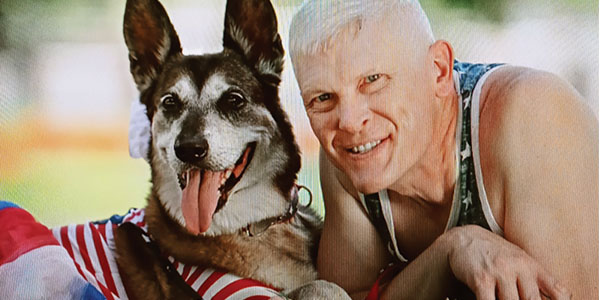
One of those ideas led Eric to a new mission: writing a book about his emotional support dog, Ciara, and the experiences they shared.
When he meets another veteran, he is quick to encourage them to try journaling.
“No one ever has to see it,” Eric says. “Don’t edit yourself. Just capture what you’re feeling.”
A Blank Page, A Brighter Future
For Angela, Joel, and Eric, journaling hasn’t changed their past. Instead, it’s given them a healthy way to process emotions, find clarity, and move forward with confidence. It’s given them hope for a brighter future.
“Journaling can be a valuable tool to help warriors improve their mental well-being and find healing,” says Margie, adding that journaling is not about how much someone writes.
“Growth happens over time when you show up for yourself consistently.”
Contact: Cynthia Weiss – Public Relations, cweiss@woundedwarriorproject.org, 904.738.2589
About Wounded Warrior Project
Wounded Warrior Project is our nation’s leading veteran services organization, focused on the total well-being of post-9/11 wounded, ill, or injured veterans. Our programs, advocacy, and awareness efforts help warriors thrive, provide essential lifelines to families and caregivers, and prevent veteran suicides. Learn more about Wounded Warrior Project.
Army veteran Steven Swiger wasn’t injured at war and always felt like Wounded Warrior Project® (WWP) resources shouldn’t be wasted on him. Rather, his injury happened during a training...

“Life has changed quite drastically,” says Army veteran Bill Geiger, reflecting on the 10 years since he decided to get help for his post-traumatic stress disorder (PTSD). “Back then, I was...
Marine veteran Nick Morrison had four days to transition from a battlefield in Fallujah, Iraq, to his home in Bloomington, Indiana. One year after his return home...